

Utilization and disposal technology of sludge in sewage treatment plant
Technology Introduction
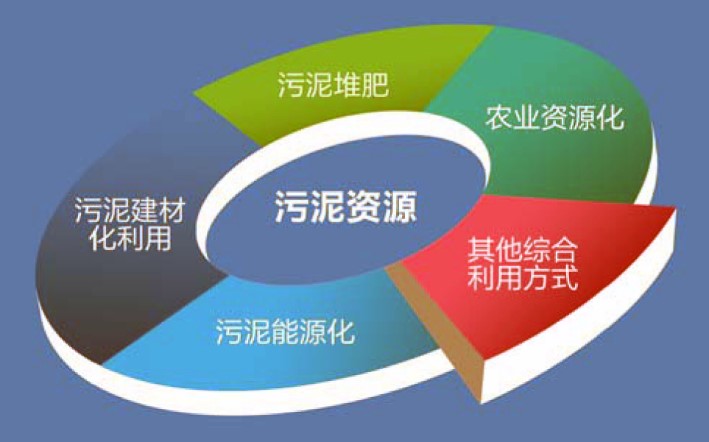
Sludge Recycling technology is to make full use of the useful ingredients in the sludge, realize the waste, from the wastes into available resources, and in line with the strategic policy of sustainable development, conducive to the establishment of circular economy, has been widely concerned in recent years. Division I through and domestic mainstream suppliers, currently has advanced sludge dewatering, drying, resource utilization of sludge and process technology system solutions.
dewatering Technology
of sludge Gao Gan the traditional sludge dewatering process is sludge after the addition of Pam conditioning (Pam added amount of 2 or so), by the belt filter press or centrifuge dehydration, the treatment of sludge can only reach 15-20%. Reference to our company's industrial wastewater Sludge treatment Project successful experience, sludge treatment should be considered first chemical modification to change the characteristics of slurry, combined with the current curing efficiency of high pressure diaphragm pressure filter press for high-pressure press dehydration, so that the sludge can achieve more than 40% solid content, can achieve the maximum sludge reduction, Further reduce the moisture content of the sludge. sludge Gao Gan dewatering process process:
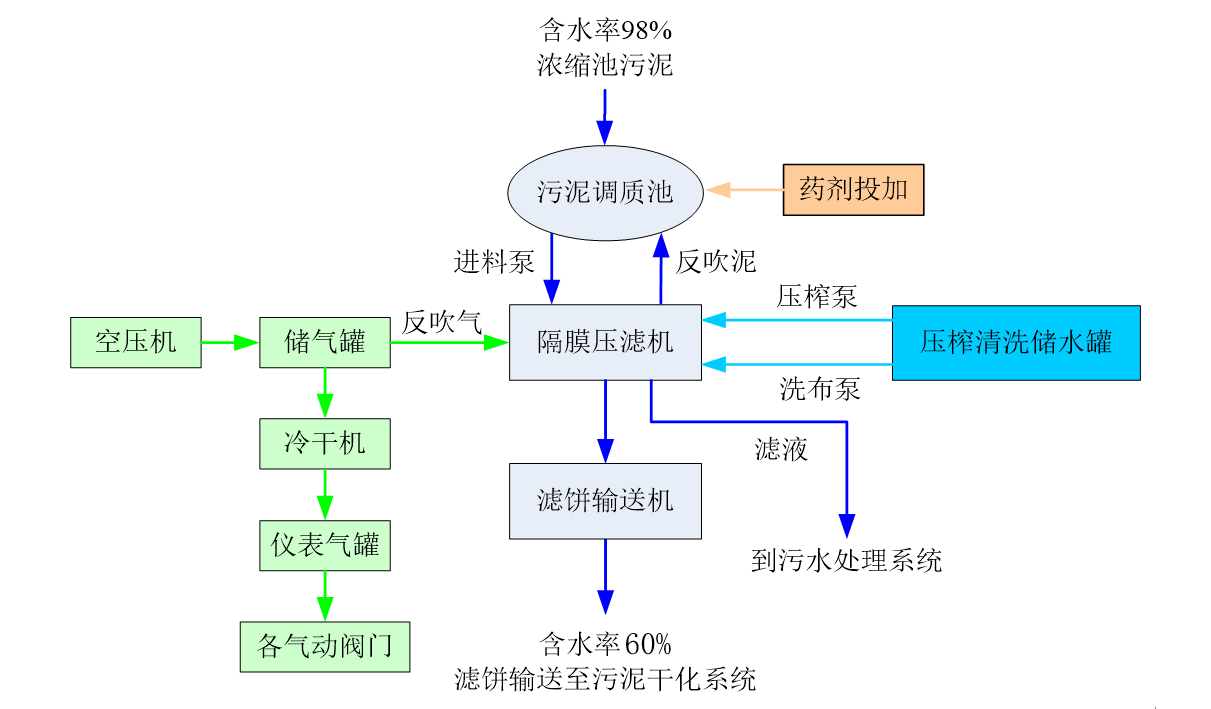
Sludge Gao Gan dewatering technology characteristics and technological advantages:
(1) The chemical and physical synthesis method to the sludge to modify, so that the sludge particles on the surface of the water and capillary pore water to make it into free water, and finally through the special mechanical pressure filter discharge, To maximize the solid content of the sludge filter Cake
(2) through the use of special modification conditioner sludge conditioning, and then through the plate-box dewatering sludge drying, can be the sludge moisture content from about 98% to 60% below, and suitable for burning power plants.
(3) using gradient feed sludge Gao Gan dehydration control technology, dehydration efficiency is higher than traditional technology;
(4) compared with traditional mechanical dehydration belt dewatering machine, sludge moisture content reduced to 60%, volume decreased by 45%, and the hardening treatment of sludge was realized, The sludge has no foul odor and no leaking fluid, and avoids two times pollution in the process.
Sludge Drying Treatment system
Sludge Drying process process:
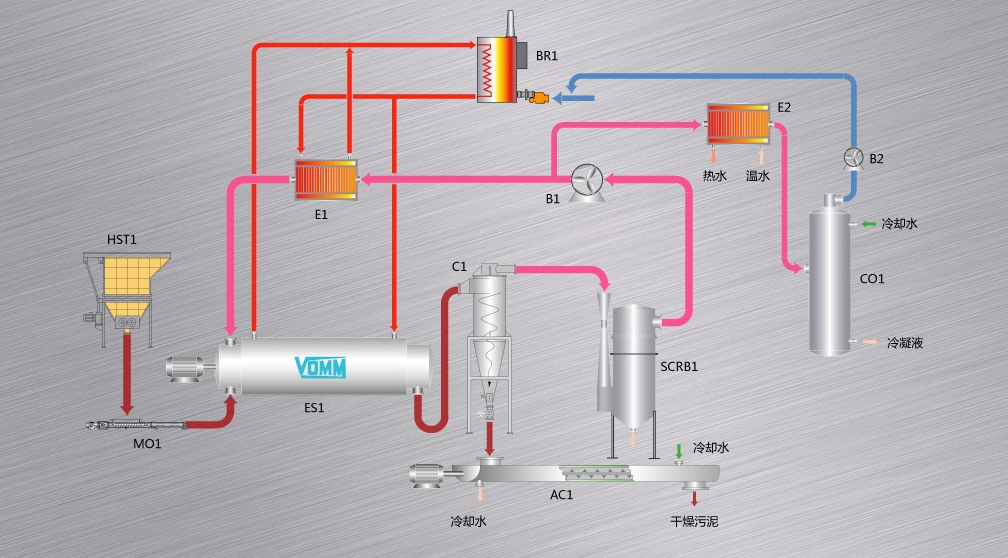
HST1: Feeder ES1: Horizontal turbine thin layer dryer C1: Cyclone separator AC1: Screw Conveyor
SCRB1: Washing and dedusting device B1, B2: Centrifugal fan E1, E2: Heat exchanger CO1: Condensing Tower
Sludge Drying System principle:
Sludge drying system mainly includes sludge feeding device, product drying device, gas-solid separation device, gas dust and circulation, non-condensate gas extraction, waste heat recovery and water vapor condensation.
① Sludge feeding device: after dehydration the wet sludge is transported to the feeder HST1, fed into the dryer by the feeder
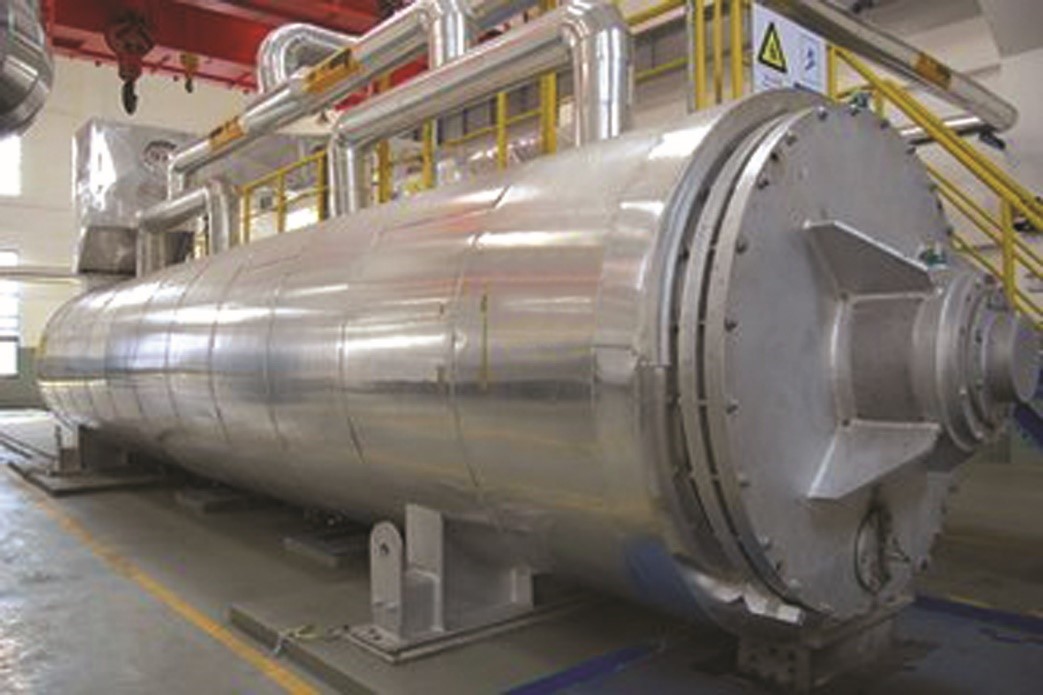
;② product drying Device: The sludge reaches the horizontal turbine thin layer dryer, This is also the entrance to the craft gas. Therefore, the gas and sludge in the dryer in the same movement. The main structure of the dryer consists of a horizontal enclosed cylindrical dryer and a horizontal shaft rotor at the center, and a horizontal shaft rotor equipped with a specially designed shape and angle of the blades, the rotor and the blades rotating under the motor drive when working. When the sludge enters the dryer, it is quickly dispersed into small particles under the action of the rotating blades, and is flung to the inner wall of the cylindrical drying drum with high temperature around the rotating centrifugal force of the rotor. When the sludge particles hit the inner wall of the drying drum, high moisture content of the sludge particles surface contact with high-temperature drying drum wall, surface moisture quickly evaporated into the gaseous, and in the sludge particles and drying drum surface formation cushion, at the same time under the mechanical impact of the sludge dispersed into smaller particles. The gas inside the dryer, in the specific shape and angle of the blades to rotate and fixed the wall of the drying drum under the joint action, forming a turbine-like high temperature airflow, driving loose small sludge particles move to form a turbine drying thin layer. The turbine drying thin layer clings to the inner wall of the drying drum under the force of the eddy current formed in the equipment, continuously directs the movement and forms a good mixing effect. This kind of drying material thin layer way may achieve the very high heat efficiency and the heat utilization efficiency. The main heat exchange is realized by circulating steam heat conduction in the jacket with the cylindrical dryer drum, while the auxiliary heating and drying material conveying is done by preheating gas. The contact and flow movement of preheating gas and sludge will not cause degradation and damage of products. In fact, the hot air at the inlet of the dryer is in contact with the cold products with high moisture content to avoid the overheating of the dry mud. System operation, generally in the turbine thin-layer dryer to stay in the largest quantity of products only dozens of kg (dry matter, according to the arrangement of workflow changes). Even if a sudden power outage, the whole system motor stopped running, the mechanical inertia of the rotating turbine can also ensure that the turbine thin layer dryer inside the processing material is basically emptied, avoid the retention of large amounts of material may be harmful to the system reset, restart. The turbine rotor is composed of a rotating shaft and a special shape of blades plated with wear-resistant materials. The rotor is mounted on the rack bearing on the centerline of the two flange connection end plate. The rotor supports and rotates the bearing group installed in the evaporation outside, so there is no risk of fouling and overheating. The dried sludge particles are driven away from the turbine thin-layer dryer by the airflow and enter the separating section with water vapor.
③ gas-Solid separation device: The turbine thin-layer dryer after the treatment of products into the cyclone C1. In a cyclone, solids and gases are separated by density differences, and dry products are collected at the bottom, while gases depart from the top. The drying products collected in the cyclone separator C1 fall into the screw conveyor AC1. The closed loop loop keeps the micro-negative pressure and avoids any dust emitted into the environment. The cyclone separator is equipped with proper insulation to avoid the risk of vapor condensation. At the bottom of the cyclone separator C1, the rotary valve VS1 is installed. After the separation of the valve through the solid products into the screw conveyor AC1.
④ gas dust and circulation: The gas leaving the cyclone separator into a washing and dedusting device SCRB1 for dust removal. The dust enters the water and the clean gas loops back into the loop. The circulating process gas is extracted by centrifugal fan B1 and recycled into the closed loop drying circuit. The circulating gas is fed into a heat exchanger E1, which is heated by saturated steam through a heat exchanger, and the heated gas is returned to the turbine thin layer dryer.
⑤ non-condensate gas extraction: in order to avoid gas emissions to the drying workshop, by the fan B2 to keep the closed circulation of micro-negative pressure. The pumping point of the drying loop is located on the hub connecting the centrifugal fan cycle and the heat exchanger.
The amount of process gas taken from the loop is controlled by the pressure probe, which starts a pneumatic control valve. A small amount of waste gas, which may contain an incompressible gas, is taken from the drying loop and condensed, and sent to a deodorization device along with the stench of wet mud storage and a buffer hopper.
⑥ waste heat recovery and water vapor condensation: The vapor from the fan B2 extraction of the condensate gas is first introduced into the condensate tower CO1 for condensation. In the condensing tower the gas is reversed by water through a pall ring packing layer. The condensation of water vapor is accomplished by the combined effect. The condensate is collected at the bottom of the condensing tower and discharged in an overflow manner. In order to reduce water consumption, the liquid is P2 by centrifugal pump to the top of the condensing tower, and the condensate is cooled by plate heat exchanger e2a/b. The circulating condensate and water are cooled by the countercurrent cooling water refrigeration. sludge drying characteristics and advantages:
Sewage Treatment plant in the initial sinking,
Biochemical and deep treatment of sludge, the use of ordinary sludge dehydration, the water content of more than 60%, sludge water content of high sludge volume, the subsequent sludge disposal also brings great difficulties and high disposal costs. After the sludge has been dried, the solid content can reach more than 70%, sludge volume significantly reduced, the formation of granular or powdery stable products, sludge characteristics greatly improved, so that the sludge after drying more easily be followed up, such as fertilizer, soil improvers, alternative energy, so whether landfill, incineration, agricultural use or thermal utilization, Sludge drying process is an important step.
Sludge Drying Technology Advantages:
(1) sludge reduction of more than 98% (in order to enter the mud with a solid rate of 99% accounting), Significantly reduce the subsequent disposal of this
; (2) sludge has a solid ratio of more than 70%, the shape and characteristics of the sludge changes: The sludge is stable fine granular, and then the water is very poor, long-distance transportation and storage
are very safe; (3) As the water content is greatly reduced, After drying, the calorific value of the sludge is increased, which is convenient for subsequent incineration, so as to finally reach the disposal requirement of "reducing, stabilizing, harmless, and resource".
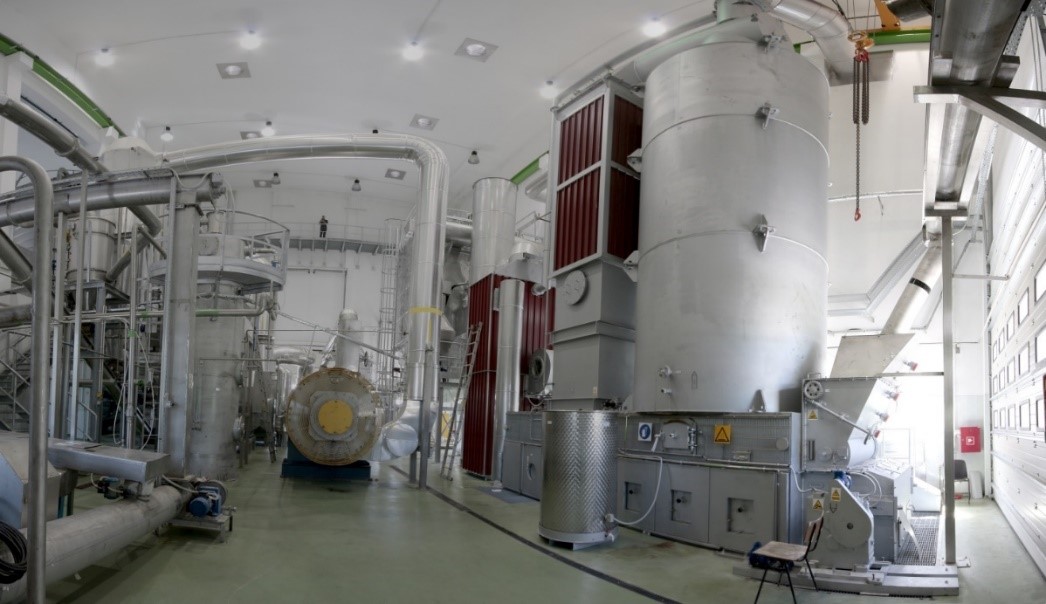
Sludge steam drying Energy disposal system
Weishui Star (Beijing) Environmental Technology Co., Ltd.
Address: Building 25, Hepingli 7th District, Dongcheng District, Beijing Tel: 010-6406 7230 13810831170 Fax: 010-6405 7458   WeChat public number: W-Startech 备案号:ICP备12034271号 | 
关注微信公众号 |